
In a typical American factory around 1900, all the power came from one place. A steam engine, or in an older mill a water wheel, turned an iron shaft about three inches thick that hung from the ceiling and ran the full length of the floor. Belts dropped from pulleys on that shaft to the machines below, and smaller countershafts branched off it toward the corners. When the engine started in the morning the whole network began to turn. It kept turning until the engine stopped at night, as Warren Devine wrote in his 1983 history of the transition, “no matter how many machines were actually being used.”11 Warren D. Devine Jr., “From Shafts to Wires: Historical Perspective on Electrification,” Journal of Economic History 43, no. 2 (1983): 347–72, at 350 and 352, as quoted in Andrew Atkeson and Patrick J. Kehoe, “The Transition to a New Economy After the Second Industrial Revolution,” NBER Working Paper 8676 (2001), 6–7.
The shaft decided the shape of the building. A very long shaft wasted power turning itself, so factories went up instead of out, in multistory structures braced to carry heavy shafting and belt housings overhead. Machines sat where the power could reach them. In 1899, electric motors supplied less than 5 percent of the mechanical drive in American manufacturing.22 Paul A. David, “The Dynamo and the Computer: An Historical Perspective on the Modern Productivity Paradox,” American Economic Review 80, no. 2 (1990): 355–61, at 356. The figure counts both primary and secondary motors. By 1919 the share was just over half. By 1929 it was nearly 80 percent.33 Paul A. David and Gavin Wright, “General Purpose Technologies and Surges in Productivity,” University of Oxford Discussion Papers in Economic and Social History, no. 31 (1999), Figure 1, derived from Richard DuBoff’s 1979 series. Yet electrification did not show up in manufacturing productivity until the early 1920s, which, as the economist Paul David pointed out, was “four decades after the first central power station opened for business.”
Most of those four decades went into learning what the motor was for. Factory owners started with the obvious move. They took out the steam engine, put a big electric motor in its place and left the shafts and belts where they were. The gains came later, when engineers put a small motor on each machine, took the shafting down and built single-story plants laid out around the flow of materials. That second step changed the building, the jobs inside it and the way it was run. We think most companies adopting AI today are somewhere in the first step. That is a reasonable place to be, for a while. The history suggests it is a bad place to stay.
Everywhere but the statistics
In July 1987 the economist Robert Solow reviewed a book about American manufacturing for the New York Times Book Review. In it he made a remark that economists have been arguing with ever since: “You can see the computer age everywhere but in the productivity statistics.”44 Robert M. Solow, “We’d Better Watch Out,” review of Manufacturing Matters, by Stephen S. Cohen and John Zysman, New York Times Book Review, July 12, 1987, 36. The line is often misquoted as “We see the computers everywhere.” Everyone felt they had lived through what he called “a technological revolution, a drastic change in our productive lives,” and productivity growth had slowed down anyway, in Japan as well as at home.
Three years later the economic historian Paul David answered him with the dynamo. His paper was short, under ten pages in the conference issue of the American Economic Review, and its argument was simple. In 1900, he wrote, “contemporary observers well might have remarked that the electric dynamos were to be seen ‘everywhere but in the productivity statistics!’” Electric lighting was in 3 percent of American homes in 1899. Motors were a sliver of factory power. The technology was obviously important and obviously spreading, and it took about twenty more years to reach half of factory drive capacity. Only then did productivity move.
When it moved, it moved a lot. David and Gavin Wright later calculated that trend growth in labor productivity in American manufacturing went from 1.5 percent a year over 1899–1914 to 5.1 percent a year over 1919–29, and that 13 of 14 major industry groups saw multifactor productivity accelerate between the two decades.55 David and Wright, “General Purpose Technologies and Surges in Productivity.” Multifactor productivity is output per unit of labor and capital combined. In the 1990 paper David estimated that about half of the 5-point acceleration in manufacturing’s total factor productivity growth during the 1920s was accounted for, statistically, by the growth in secondary electric motor capacity over the decade.
The sequence is the point. There was a long period in which the new technology spread and the numbers sat still, and then a decade in which they jumped. David also noticed that electricity did not get real momentum until after 1914–17, when regulated regional utility rates came down substantially. Cheaper power helped. It does not explain why the same motor could be worth so much more in one building than in another.
A motor in the basement
Devine laid out the transition in four stages. First came direct drive, with a line shaft turned by a steam engine or a water wheel. Then came electric line shaft drive, in which one large motor replaced the engine and everything else stayed put. After that came group drive, where several motors each turned a separate section of shafting, so that each motor drove a related group of machines. Last came unit drive, in which every machine had its own motor.
Group drive lasted a long time. David writes that it “remained in vogue” from the mid-1890s to the eve of the 1920s. It was a sensible upgrade that used electricity to do what the steam engine had done. But retrofitting an existing plant, David writes, “typically entailed adding primary electric motors to the original stock of equipment.” The belts, pulleys and shafts stayed in place. The firm now owned the old transmission system and the new motors, so it had more capital for roughly the same output, and that “militated against rapid gains in total factor productivity.”
Unit drive changed what a factory could be. With a motor in each machine, the heavy overhead shafting was gone, and so was the need to brace the building to carry it. Factories could be built on one floor, which was cheaper than the multistory structures that long shafts had required. On one floor, machines could be arranged in the order the work moved through them. Materials handling got closer attention. Machines could be moved as needs changed, and in David’s phrase, “the entire power system no longer had to be shut down in order to make changes in one department or section of the mill.” Devine’s own summary is that electricity reduced the energy needed to drive machinery, “but more important, enabled industry to obtain greater output per unit of capital and labor input.”
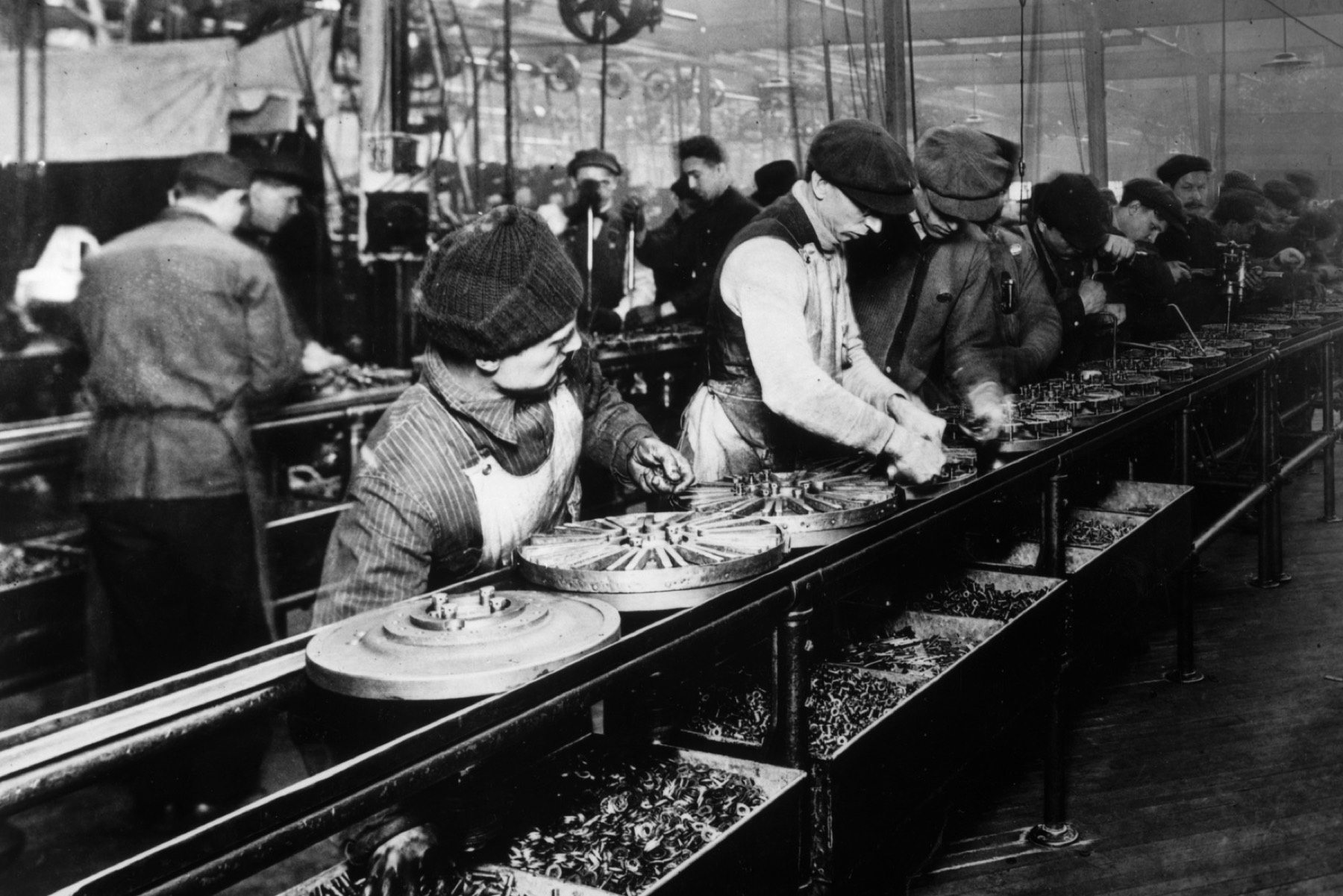
The most famous example of a factory laid out around the work is Ford’s. On October 7, 1913, the company rigged a rudimentary moving final assembly line at its new Highland Park plant in Michigan. By the company’s own account, the time to produce a single vehicle fell from 12 hours and 30 minutes to 5 hours and 50 minutes.66 Ford Motor Company, “Highland Park,” corporate heritage page (archived 2008). Later figures of 93 minutes by 1914 appear in sources both as assembly time per chassis and as the interval between finished cars; see Matt Anderson, “Ford Methods and the Ford Shops,” The Henry Ford, July 22, 2021. They measure different things. The moving line drew on much more than electricity. Ford had first tried one on flywheel magnetos around April 1913, and the method owed a great deal to that kind of experiment. But it shares the shape of the unit-drive story. Once a plant no longer had to be arranged around a power source, it could be arranged around the path a part took from raw stock to finished car.
None of this happened by decree. David stresses that unit drive had to be worked out “in the context of many kinds of new industrial facilities, in many different locales,” and that doing so built up “a cadre of experienced factory architects and electrical engineers familiar with the new approach to manufacturing.” The bottleneck was knowledge of how to lay out a factory that no longer had a shaft running through it. That knowledge was spread across thousands of plants and had to be learned in each.77 Ajay Agrawal, Joshua Gans and Avi Goldfarb retell this history as a parable of three entrepreneurs in Power and Prediction: The Disruptive Economics of Artificial Intelligence (Harvard Business Review Press, 2022), ch. 1, explicitly building on David.
Why owners waited
It is tempting to read the forty years as a failure of nerve. That reading is mostly wrong. From inside a single firm, keeping the shafts made sense most years.
Start with the building. A multistory mill with its shafting in place was paid for and would last for decades. A big motor in the basement could replace the steam engine without touching any of that. Unit drive, done properly, often meant a new building, and the gains depended on the new layout, which depended on knowing what the new layout should be. Few plant managers in 1905 could say. The architects and engineers who could were still learning, one plant at a time. Power was also expensive until regulated rates fell in the second half of the 1910s, so the motor-per-machine plant was a bet on a price that had not yet arrived.
There is a subtler reason, which is that half a redesign bought very little. A firm that put motors on some machines and kept the shafting for others carried both costs and got neither building. The gains from unit drive came as a package: the motor, the single floor, the new layout, the new materials handling, and a workforce and management that knew how to run the result. A firm that couldn’t do all of it might rationally do none of it, and wait until the old plant wore out or the business outgrew it.
So the lag was rational for each firm and expensive for the economy, which is a common combination. It also means the lag was not a measurement error. The productivity really wasn’t there yet, because the factories that would produce it hadn’t been built.
The same arithmetic applies to a company today, with different assets. Its sunk plant is the software it already pays for and the habits of the people who use it. Both work. Redesigning a department around AI means tearing up part of each, and the payoff depends on knowing what the redesigned department should look like, which few companies can yet say. In any given quarter, keeping the shafts turning is the defensible choice. The trouble is that it stays defensible, quarter after quarter, while someone else learns the new layout.
Economists now have a name for the shape. In a 2021 paper, Erik Brynjolfsson, Daniel Rock and Chad Syverson argued that general-purpose technologies require large complementary investments, mostly intangible: redesigned business processes, new skills, the slow work of figuring out what the technology is for.88 Erik Brynjolfsson, Daniel Rock and Chad Syverson, “The Productivity J-Curve: How Intangibles Complement General Purpose Technologies,” American Economic Journal: Macroeconomics 13, no. 1 (2021): 333–72. National accounts mostly miss those investments. So in the early years, firms are building something real that the statistics don’t count, and measured productivity looks worse than it is. Later, when those investments start producing measured output, productivity looks better than it is. Plotted over time, the gap between measured and true productivity traces a J. The authors estimate that adjusting for intangible investment tied to computer hardware and software would put the level of total factor productivity 15.9 percent above official measures by the end of 2017. That is a measure of how much the computer era’s invisible building work may have been undercounted, decades after Solow’s remark.
The obvious question is whether AI is on the same curve. The Stanford AI Index for 2026 reported that American productivity growth reached 2.7 percent in 2025, nearly double the 1.4 percent average of the previous decade, and noted Brynjolfsson’s view that this “may reflect the early stages of a ‘J-curve,’ where organizations absorb the costs of adopting AI before the larger productivity gains show up in the numbers.”99 Stanford Institute for Human-Centered Artificial Intelligence, Artificial Intelligence Index Report 2026, ch. 4. The 2.7 percent figure is Brynjolfsson’s own estimate, published in the Financial Times in February 2026. The same chapter cites a survey of 6,000 executives that found “widespread adoption but minimal realized productivity gains.” Both can be true at once. A J-curve predicts years in which executives feel the cost and see little of the return.
Tyler Cowen has made the case for patience as plainly as anyone. In a January 2025 conversation with Dwarkesh Patel he guessed that AI would “boost the rate of economic growth by something like half a percentage point a year,” and added, “Over 30-40 years, that’s an enormous difference.” His reason for the modest number was diffusion. “The people who study diffusion of new technologies never think there will be rapid takeoff,” he said. “It’s going to be a tough slog, like the printing press, like electricity.”1010 Tyler Cowen, interview by Dwarkesh Patel, “Tyler Cowen: The #1 Bottleneck to AI Progress Is Humans,” Dwarkesh Podcast, January 9, 2025.
Today’s line shaft
If AI is a general-purpose technology on the scale of electricity, which is the premise of a great deal of current investment and is not yet proven, then the useful question for an executive is what the line shaft is in a modern company. What is the thing that everything else is arranged around, that keeps turning all day whether or not anyone needs it, and that a new power source could make unnecessary?
Our answer, and it is an opinion, is the organization built around human handoffs and held together by rented software. Consider how a request moves through a typical mid-sized company. A customer emails a salesperson, who enters the order in one system. Someone in operations re-keys it into another. A third person exports a report into a spreadsheet for the Monday meeting, where a manager reads it aloud. Each handoff is a belt. Each application is a pulley sized by its vendor for the average customer. Sam Gaddis, one of this magazine’s editors, has described the problem with rented software this way: vendors “have to build to the lowest common denominator and build the features that the most people want.” The company’s processes bend to fit the tool, and over the years the bend becomes the process.
Group drive, in this picture, is giving everyone an AI assistant and leaving the handoffs where they are. The assistant drafts the email faster, summarizes the meeting, writes the first pass of the report. Each of those is a real improvement, the way a motor in the basement was a real improvement over a steam engine. But the order still gets re-keyed, the report still gets exported, and the Monday meeting still happens because nobody can see the numbers any other way. The firm now pays for the old system and the new one. Its capital, in David’s terms, has gone up faster than its output.
The handoffs are harder to see than a shaft. They look like people doing their jobs, and they are. One of the more useful things we have watched in our own work is what happens when a company tries to remove a piece of rented software and finds out how much of the company was living inside it.
An aviation-training company we work with moved its courses from the learning platform it had used for years to a different one. The new platform had a different structure and different capabilities, and the feedback afterward was that the company itself felt changed. Jonathan Layton, a Runpoint engineer on the project, thought the feedback was accurate. In a team meeting in August he said the old platform had been “the backbone that forced people with a different vision to compromise on one thing.” Its limits had been forcing agreement inside the company. Once it was gone, as Jonathan put the realization, the company could see that “we were actually outsourcing 50% of our entire company’s existence to this other software.”
Jonathan connected this to an old rule of software engineering called Conway’s Law, which holds that a system’s design mirrors the organization that built it. His version is sharper. “The coherence of your software cannot be greater than the coherence of the group,” he said. “Software helps people go fast. So if people are not on the same page, then all you’re going to do is accelerate the disagreement.”
That is the factory problem in modern form. A plant could not move to unit drive until somebody knew how the work should flow through a building with no shaft in it. A company cannot redesign a department around AI until somebody knows how the work in that department actually runs, which is often different from how the org chart or the software says it runs. In a September meeting I put it this way: “The way you actually do work is not how you think it’s supposed to do work.” In our own projects, sitting with people until they explain how the work really runs takes more time than writing the software. That extraction is the modern version of David’s cadre of factory architects, and it has to be done again at each company, the way the factory work had to be done in each plant.
The unit-drive equivalent, then, is redesigning the work around the new capability. Runpoint’s own homepage says “We rewire whole departments, from the first request to the final report.” We sell that, so the reader should discount our enthusiasm for it accordingly. The historical argument does not depend on us. It says the gains arrive when the layout changes, and that buying the new power source and keeping the layout gets you a modest improvement and a larger capital bill.
What surprises executives is how unglamorous the redesign usually is. Unit drive was a small motor on each machine, a dull component. Its value came from what it let the building become. The AI equivalent is often just as dull. Talking with the general manager of an aluminum mill in September, Sam laid out the conventional story, in which companies move from deterministic software to workflows run by language models, and then disagreed with it. “Usually the best use case of AI, from my perspective, is to build that deterministic software faster, better and efficiently in a way that you never could,” he said, “rather than using the LLMs to do actual work.” He admitted the cost: “It’s less fun, but it’s much more powerful.” Deterministic software is ordinary software that does the same thing every time. Built quickly and fitted to how one company actually works, it can take out the re-keying, the export and the meeting that exists only because the numbers live in five places. In this framing the model is the motor. The new layout is the department that no longer needs the handoffs.
Faster in some ways
Every historical analogy flatters the person using it, and this one has real gaps.
Some of them point toward faster diffusion. The factory owner of 1910 had to put up a new building. A company redesigning a department today mostly has to rewrite software and retrain people, and the first of those has become much cheaper. For the kind of internal systems a mid-sized company runs on, the build is no longer the bottleneck. The tools arrive through a browser instead of a utility line. The technology itself improves every few months, a pace no dynamo matched. And the knowledge of how to redesign can spread faster than it could in 1910, when it traveled with engineers from plant to plant.
Other gaps point the other way. A motor either turns or it doesn’t, and the plant manager could see it. AI systems are uneven in ways that are hard to see, and trust, once lost, is slow to return. A skeptical employee who has one bad experience with a new tool may not try it again for a long time. Data is the second drag. A unit-drive factory needed electricity at the wall; an AI-redesigned department needs its own records clean, connected and trusted, and in our experience they rarely are. Regulation is the third. Cowen, in the same conversation, counted it among his bottlenecks: “at the end of it all is still our system of clinical trials and regulation.” In a talk in May 2026 he argued, as Fortune reported it, that something like 40 to 50 percent of American GDP, including government, higher education, health care and nonprofits, would be “very slow to adjust.”1111 Nick Lichtenberg, “Top Economist Tyler Cowen on the Biggest Problem of the AI Age,” Fortune, May 22, 2026, reporting remarks at the Sana AI Summit in New York. The percentage is Fortune’s paraphrase; “very slow to adjust” is Cowen’s.
So the honest summary of the analogy is that it tells you the shape of the problem and nothing about the timing. Nobody can read a date for AI off the 1899–1929 series. Four decades was the time it took a particular technology, under particular conditions, to reorganize one sector of one economy. The lesson we take from it is narrower: that the payoff from a general-purpose technology tends to arrive when firms redesign around it, and that the first, cautious adoption looks a lot like progress while it is happening.
Runpoint’s master plan, published on the firm’s website, puts the stakes in generational terms: “Electricity got one generation, computation another. This one is ours, and it will not last long.” That is a claim about urgency, and the claim belongs to us; David made none like it. His data says something more patient. In his account, the payoff of the 1920s came only after decades of learning what to do once the shaft came down. Buying the motor had been the easy part.
Picture a plant engineer in 1910, standing under a line shaft with a motor catalog in one hand, working out whether to tear up a building that still has thirty years in it. He keeps the shaft, and for most of the decade that is the right answer. Somewhere in town, someone with a smaller budget and no old building is pouring a single-story floor. The question for an executive now is which of those two people you are paying, and whether you would know the difference from the next quarter’s numbers.
